
quarta-feira, 16 de junho de 2010


quarta-feira, 26 de maio de 2010
1. Adicione S ou ES aos verbos nas sentenças se necessário. Se não for necessário, coloque um X no espaço em branco.
a) He work_s__ in a bank.
b) They live_x__ in France.
c) I watch_es___ TV every day.
d) She go_s___ to work by car.
e) The film finish_es___ at ten o'clock.
f) We play_es___ tennis every weekend.
g) They go_s___ on holiday in August.
h) He speak_es___ Italian and French.
i) She do__es___ her homework every night.
2. Escreva frases, usando a forma negativa do Present Simple:
a) (He/not/live/ in Mexico) He doesn't live in Mexico.
b) (She/not//work/in a bank) she in a bank not work ________________________________________________
c) (I/not/play golf) I GOLF NOT PLAY
__________________________________________
d) (Paul/not/listen/to teh radio) she paul not listen to teh radio __________________________________________
e) (We/not/speak/French) he not speak french __________________________________________________
f) (You/not/listen/to me!) she you not listen to me!
____________________________
g) (My car/not/work) I my car not work_____________________
h) (I/not/drink/tea) she i not drink tea
i) (Sheila/not/eat/meat) you sheila not aet meat
3. Complete os espaços com a conjugação correta dos verbos no Presente Simples do inglês.
Kristin_krie___________(wake up) everyday at 7. She___________(brush) her teeth and then_teeth and then takies_________(take) a shower. Then she_meets__________(meet) with her friend Jennifer and together they_havies___________(have) breakfast at a little diner near the office. They_gets________(get) to the office at around 8:30. Kristin__________(go) to the first floor, where she___________(work), and Jennifer____________(take) the elevator to the 11th floor, where her office___________(be). Later, they____________(meet) again at 12 to have lunch.
4. Complete os espaços com a opção correta: do, does, don't, doesn't, is, isn't, are ou aren't:
a.________you like ice-cream?
Yes I_______. I think everybody_________.
b.________ Kim from Australia?
Nope, she________actually Canadian.
c. We__________like the beach very much this time of the year. We prefer the mountains.
Really? Why_______that?
Beaches_______too crowded in the summer.
_________you always go to the mountains in the summer?
About every two years. It_________a shame that we have more free time to travel.
d. How often__________you go to the movies?
Every week or so. I like to watch all the comedies, but I really___________like horror movies.
Really? Horror movies__________my favorite ones.
e. Rose__________here yet. Where_______she?
Oh, she_______late because of the traffic.
Ok, we can wait.__________she have a car?
No, she_________. She always takes a cab.
f._________those your friends from Spain?
They__________my friends, but they___________Spanish. They__________actually from Argentina.
Oh. __________they go to the same school that you go?
No, they___________students. They________ac
a) He work_s__ in a bank.
b) They live_x__ in France.
c) I watch_es___ TV every day.
d) She go_s___ to work by car.
e) The film finish_es___ at ten o'clock.
f) We play_es___ tennis every weekend.
g) They go_s___ on holiday in August.
h) He speak_es___ Italian and French.
i) She do__es___ her homework every night.
2. Escreva frases, usando a forma negativa do Present Simple:
a) (He/not/live/ in Mexico) He doesn't live in Mexico.
b) (She/not//work/in a bank) she in a bank not work ________________________________________________
c) (I/not/play golf) I GOLF NOT PLAY
__________________________________________
d) (Paul/not/listen/to teh radio) she paul not listen to teh radio __________________________________________
e) (We/not/speak/French) he not speak french __________________________________________________
f) (You/not/listen/to me!) she you not listen to me!
____________________________
g) (My car/not/work) I my car not work_____________________
h) (I/not/drink/tea) she i not drink tea
i) (Sheila/not/eat/meat) you sheila not aet meat
3. Complete os espaços com a conjugação correta dos verbos no Presente Simples do inglês.
Kristin_krie___________(wake up) everyday at 7. She___________(brush) her teeth and then_teeth and then takies_________(take) a shower. Then she_meets__________(meet) with her friend Jennifer and together they_havies___________(have) breakfast at a little diner near the office. They_gets________(get) to the office at around 8:30. Kristin__________(go) to the first floor, where she___________(work), and Jennifer____________(take) the elevator to the 11th floor, where her office___________(be). Later, they____________(meet) again at 12 to have lunch.
4. Complete os espaços com a opção correta: do, does, don't, doesn't, is, isn't, are ou aren't:
a.________you like ice-cream?
Yes I_______. I think everybody_________.
b.________ Kim from Australia?
Nope, she________actually Canadian.
c. We__________like the beach very much this time of the year. We prefer the mountains.
Really? Why_______that?
Beaches_______too crowded in the summer.
_________you always go to the mountains in the summer?
About every two years. It_________a shame that we have more free time to travel.
d. How often__________you go to the movies?
Every week or so. I like to watch all the comedies, but I really___________like horror movies.
Really? Horror movies__________my favorite ones.
e. Rose__________here yet. Where_______she?
Oh, she_______late because of the traffic.
Ok, we can wait.__________she have a car?
No, she_________. She always takes a cab.
f._________those your friends from Spain?
They__________my friends, but they___________Spanish. They__________actually from Argentina.
Oh. __________they go to the same school that you go?
No, they___________students. They________ac
terça-feira, 18 de maio de 2010
Colonização Espanhola
1°.a)Qual o pretexto da Espanha colonizar a América Latina?
Espanha utilizou como pretexto para colonizar a América Latina a necessidade de civilizar os povos americanos, através da cultura e da fé cristã. Ao contrário do que aconteceu na colonização do Brasil, na América Latina os metais preciosos foram achados logo de imediato e sua extração foi o eixo econômico da colonização espanhola e, portanto, se teve colônias de exploração.
B)Quem eram os Chapetones?
Os Chapetones eram colonos nascidos na Espanha, porém, viviam na América, ocupavam os principais cargos administrativos, militares e religiosos.
C)O que era a Encomienda?
Forma de trabalho compulsório durante a conquista espanhola nas américas a partir de 1503. Consistia em um certa quantidade de indígenas entregues a um colono espanhol, para quem deveriam trabalhar em troca de assistência material e religiosa. E o termo "Encomienda" tem mesmo a ver com encomenda pois o colono espanhol deveria "cuidar" destes indígenas que eram "encomendados" pelos colonos para trabalharem para ele.
quarta-feira, 28 de abril de 2010
nomes de em espanhol
| El pato | Pato |
| El avestruz | Avestruz |
| La garza | Garça |
| El canario | Canarinho |
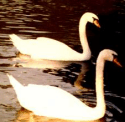
| El cisne | Cisne |
| El bienteveo | Bente-ti-vi |
| El pájaro carpintero | Pica pau |
| El pinguino | Pinguim |
| La paloma | Pomba |
| El pavo real | Pavão |
| El ganso | Ganso |
| El canario | Canário |
| El gallo | Galo |
| El condor | Condor |
| El halcón | Falcão |
| El ganso | Ganso |
| La gallina | Galinha |
| El cuervo | Corvo |
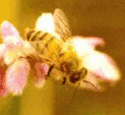
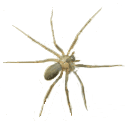
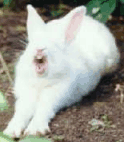
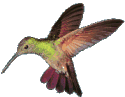
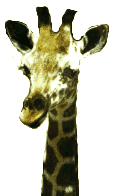
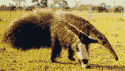
nomes de animais
|
|







sexta-feira, 16 de abril de 2010
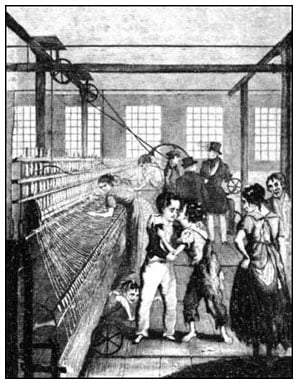


historia
Revolução Industrial
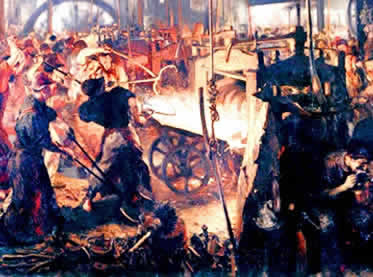
A substituição das ferramentas pelas máquinas, da energia humana pela energia motriz e do modo de produção doméstico pelo sistema fabril constituiu a Revolução Industrial; revolução, em função do enorme impacto sobre a estrutura da sociedade, num processo de transformação acompanhado por notável evolução tecnológica.
A Revolução Industrial aconteceu na Inglaterra na segunda metade do século XVIII e encerrou a transição entre feudalismo e capitalismo, a fase de acumulação primitiva de capitais e de preponderância do capital mercantil sobre a produção. Completou ainda o movimento da revolução burguesa iniciada na Inglaterra no século XVII.
Etapas da industrialização
Podem-se distinguir três períodos no processo de industrialização em escala mundial:
1760 a 1850 – A Revolução se restringe à Inglaterra, a "oficina do mundo". Preponderam a produção de bens de consumo, especialmente têxteis, e a energia a vapor.
1850 a 1900 – A Revolução espalha-se por Europa, América e Ásia: Bélgica, França, Alemanha, Estados Unidos, Itália, Japão, Rússia. Cresce a concorrência, a indústria de bens de produção se desenvolve, as ferrovias se expandem; surgem novas formas de energia, como a hidrelétrica e a derivada do petróleo. O transporte também se revoluciona, com a invenção da locomotiva e do barco a vapor.
1900 até hoje – Surgem conglomerados industriais e multinacionais. A produção se automatiza; surge a produção em série; e explode a sociedade de consumo de massas, com a expansão dos meios de comunicação. Avançam a indústria química e eletrônica, a engenharia genética, a robótica
quarta-feira, 7 de abril de 2010
Recursos Minerais
A Geografia do Brasil é um domínio de estudos e conhecimentos sobre todas as características geográficas do território brasileiro. O Brasil é o quinto maior país do mundo em área descontínua: tem 1,7% das terras emersas e ocupa 47% da América do Sul. Se forem consideradas apenas as áreas contínuas, ele passa a ocupar a 4a posição, já que os Estados Unidos possuem dois territórios externos: Havaí e Alasca. Está localizado na porção centro-oriental do continente sul-americano (entre os paralelos de 5º16' de latitude norte e 33º44' de latitude sul, e entre os meridianos de 34º47' e 73º59' de longitude oeste),[1] com seu litoral banhado pelo oceano Atlântico. O Brasil tem uma área total de 8.514.876 [2][3] km² que inclui 8.456.510 km² de terra e 55.455 km² de água. O ponto culminante do Brasil é o Pico da Neblina, com 2.994 m;[4] o ponto mais baixo é o nível do mar. O Brasil faz fronteira com dez repúblicas sul-americanas: Argentina, Bolívia, Colômbia, Guiana, Paraguai, Peru, Suriname, Uruguai, Venezuela e Guiana Francesa. Por comparação, o Brasil é um pouco menor em extensão territorial em relação aos Estados Unidos.
segunda-feira, 5 de abril de 2010

Assinar:
Comentários (Atom)